Evolution of Service Manuals into Interactive 3D Work Instructions

- Industry
- Aerospace
- Location
- Global
- Goals
- Improve execution consistency of service operations
- Type
- B2B
Technology used
-

-
Ausrine
Digital Twin Experience Platform
-

-
Progressive Web App
Cross-platform app targeting different devices and form factors
Aerospace manufacturers have digitized technical documentation. The next opportunity is making complex maintenance and assembly procedures easier to understand and execute through interactive work instructions.
Every aerospace manufacturer invests heavily in producing technically accurate maintenance documentation. Engine overhaul manuals, illustrated parts catalogs (IPC), engineering drawings, and service procedures define how complex products should be assembled, inspected, repaired, and maintained.
The challenge is no longer creating documentation. It is ensuring that complex procedures are executed consistently across manufacturing facilities, MRO operations, dealer networks, and field service teams.
As aerospace systems become more sophisticated and service operations become increasingly distributed, maintaining execution consistency becomes harder. The gap is not between engineering knowledge and documentation—it is between engineering intent and technician execution.
When static manuals fall short
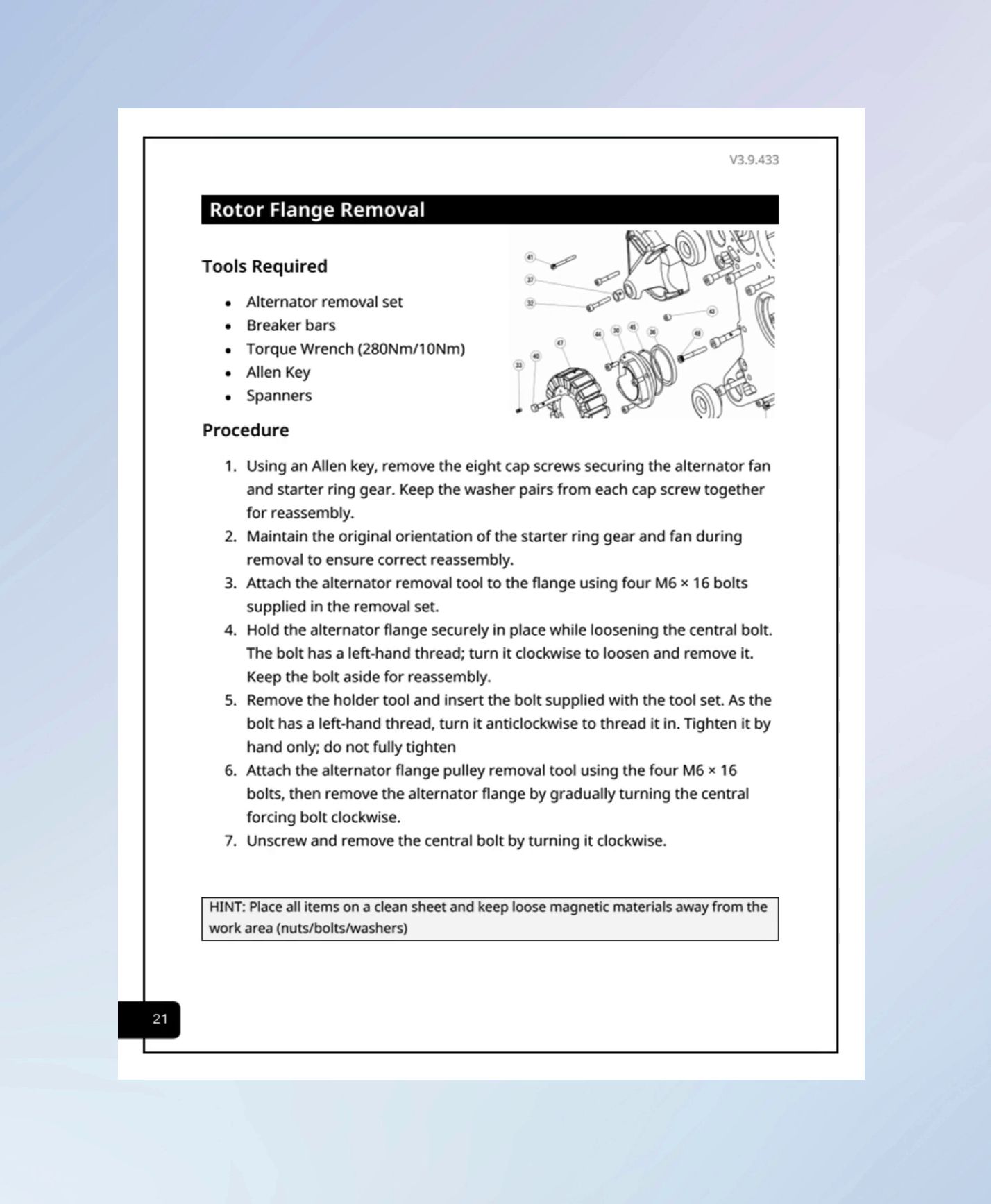
Consider a rotor flange removal during an aircraft engine overhaul.
The maintenance manual provides every required instruction: operation sequence, safety notes, tooling references, and technical illustrations. The procedure is technically complete and approved.
Midway through the process, however, the technician reaches a step where understanding the assembly becomes more important than reading the next line of text. The illustration shows the component from a fixed perspective, while the technician is working from a different angle on the engine. A retaining feature is partially hidden, and the next component becomes visible only after another part is removed.
This moment is familiar across aerospace maintenance organizations. The procedure is technically correct, but executing it still requires technicians to interpret spatial relationships that static documentation cannot fully communicate.
The execution clarity gap
Aerospace documentation communicates what should happen. Technicians also need guidance that helps them understand how it should happen while performing the work.
Modern aerospace assemblies are tightly packaged, modular, and mechanically complex. As a result, technicians frequently pause to confirm orientation, inspect neighboring components, or verify whether the assembly matches the current step before continuing.
Three industry trends make this challenge more visible today:
- Increasing product complexity requires greater spatial understanding during assembly, inspection, and repair.
- Distributed service operations require the same procedural knowledge to support OEM teams, MRO providers, dealers, and field service technicians across locations.
- Knowledge transfer is becoming a priority as organizations seek to reduce dependence on experienced technicians for complex procedures.
The opportunity is not to replace approved engineering documentation, but to improve how engineering knowledge is delivered at the point of work.
Static documentation communicates procedures. Interactive work instructions communicate spatial context.
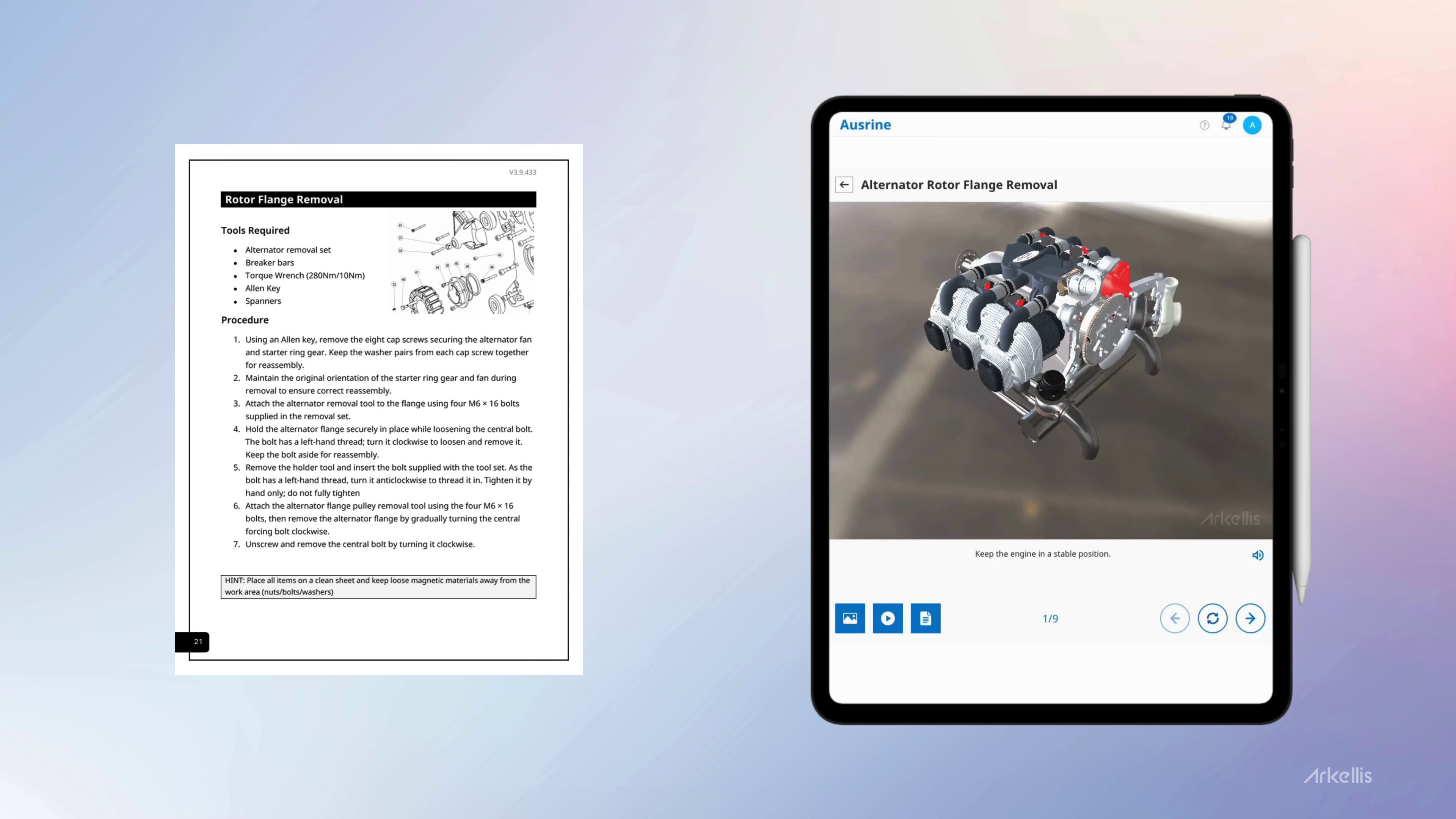
A PDF preserves the layout of a printed manual. A video demonstrates a procedure from a predefined viewpoint. Both communicate engineering information effectively, but both remain static formats.
Interactive work instructions address a different problem - Spatial Context.
Instead of interpreting an assembly from a fixed illustration, technicians can inspect the model from the angle required for the task, understand component relationships before acting, and follow guided procedural steps while performing the work.
|
Static documentation |
Interactive work instructions |
|
Fixed illustrations. |
Interactive 3D context for each step. |
|
One predefined viewpoint. |
Rotate, zoom, and inspect from any relevant angle. |
|
Read documentation before work. |
Follow guidance while performing the work. |
Not every maintenance procedure requires an interactive experience. Their value is greatest where geometry, visibility, and assembly relationships are critical to successful execution.
Where interactive work instructions create the most value
- Engine maintenance during overhaul
Procedures such as rotor flange removal require technicians to understand the assembly throughout disassembly. Interactive work instructions provide visual context for each stage while preserving the approved maintenance procedure. - Assembly on the manufacturing floor
Assembly technicians often work with engineering drawings or CAD screenshots. Interactive work instructions help them inspect each assembly step, verify how components fit together, and follow installation sequences with greater clarity. - Field service at the point of work
Field technicians rarely need an entire maintenance manual. They need the specific repair procedure for the equipment in front of them. Interactive work instructions can be accessed directly through a web browser from a service portal or QR code, reducing the effort required to locate relevant guidance.
Across all three workflows, the objective is the same: make engineering knowledge easier to apply during execution.
One procedure, multiple operational workflows
A single maintenance procedure is often reused across engineering, manufacturing, MRO, training, dealer service, and field operations.
Instead of maintaining separate versions of similar documentation, organizations can maintain one interactive work instruction that supports multiple operational teams while preserving engineering consistency.
This changes documentation from a static deliverable into a reusable operational asset that supports the product throughout its lifecycle.
Making interactive work instructions practical at enterprise scale
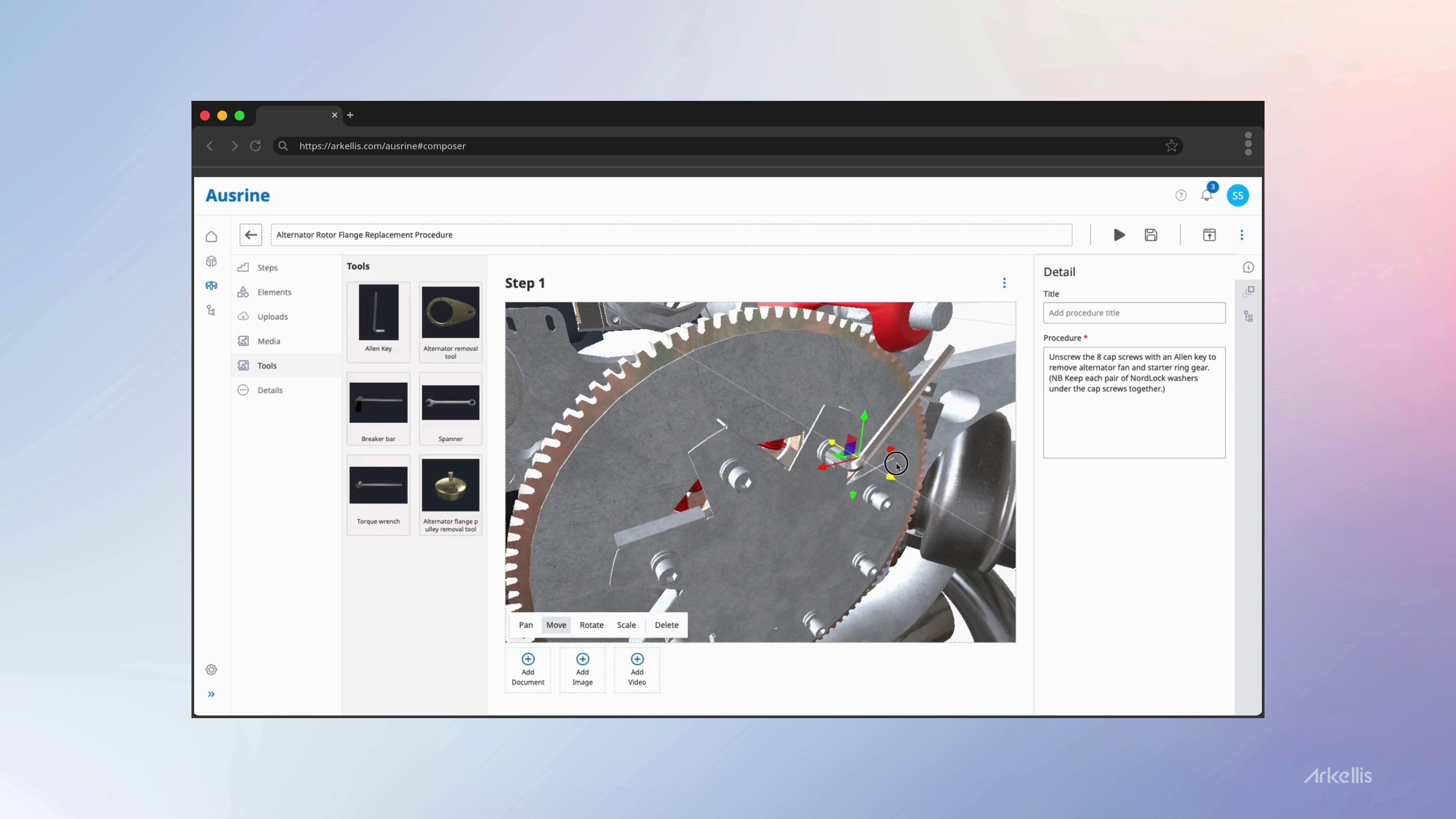
Most aerospace manufacturers already possess the information needed to define a procedure: CAD geometry, approved maintenance manuals, engineering drawings, service procedures, and years of technical documentation.
The challenge is converting those existing engineering assets into interactive work instructions that engineering and service teams can maintain as products evolve.
Ausrine Composer is an authoring application within the Ausrine platform that enables engineering teams to create interactive maintenance procedures, assembly work instructions, inspection guides, and technical walkthroughs from existing engineering documentation and 3D assets. Instead of treating each procedure as a software development project, teams can author, publish, and maintain browser-based interactive work instructions for manufacturing and aftermarket operations.
Interactive work instructions also provide visibility into how procedures are used. Engineering teams can identify patterns such as steps technicians revisit frequently or steps where technicians spend more time, helping prioritize documentation improvements during future product revisions.
The next evolution of aerospace service documentation
Maintenance manuals, engineering drawings, illustrated parts catalogs, and service procedures remain the foundation of aerospace engineering documentation. What is changing is how that knowledge is applied during execution.
Interactive work instructions do not replace approved engineering documentation. They complement it by making complex procedures easier to understand where maintenance, assembly, inspection, and field service work actually happen.
For engineering and aftermarket leaders, this is an opportunity to rethink maintenance documentation as a reusable operational asset—supporting manufacturing, technician training, aftermarket service, and continuous improvement from the same engineering knowledge.
See the rotor flange procedure in action
The rotor flange removal example used throughout this article is available as an interactive work instruction created with Ausrine Composer.
Watch the walkthrough to see how an approved PDF-based maintenance procedure can be converted into an interactive 3D work instruction for aerospace maintenance and aftermarket workflows.
Turn Complex Procedures into Clearer Guidance
Discover how interactive work instructions can help make complex procedures easier to understand.