Accelerating Quality Inspection with Synthetic Data and Digital Twin Validation

- Industry
- Engineering & Manufacturing
- Location
- Asia
- Goals
- AI-Based Quality Inspection for Fabrication and Casting
- Type
- B2B
Technology used
-
-
Synthetic Data Generation
Programmatically generate defect data sets for AI model training
-
-
Digital Twin
Mimicked the assembly setup to test and validate the AI models
-
-
Nvidia Omniverse
Designed realistic factory setup and simulations
Engineering and manufacturing face increasing demands for faster, more accurate defect detection. Traditional AI inspection systems depend on limited real‑world defect samples. By generating physics‑based synthetic defects and validating model performance inside a digital twin, manufacturers can shorten deployment timelines, lower manual inspection workload, and minimize downstream scrap and rework.
The challenge
Traditional inspection systems rely heavily on historical defect data, limiting their ability to detect the full range of issues that occur in fabrication and casting environments. Engineering teams needed a more reliable and scalable method to identify defects such as:
-
Surface cracks
-
Weld defects
-
Paint inconsistencies
-
Structural deformation
Relying solely on real‑world defect capture introduced multiple bottlenecks:
-
Rare defects lacked sufficient samples
-
Defect data collection required weeks of production time
-
Model retraining cycles were slow
-
On-site validation extended deployment timelines
These constraints left manufacturers without the broad defect coverage needed to support high‑volume, high‑precision operations—without disrupting production.
Real-world data cannot cover every scenario
Real‑world data cannot cover every scenario. Conventional AI inspection systems face inherent limitations:
-
Models are trained only on defects previously observed in production
-
Rare or edge‑case scenarios are significantly underrepresented.
-
Variations in lighting and environmental conditions are often inadequately tested
-
Commissioning requires repeated tuning, extending deployment cycles
As a result, these constraints create performance gaps when systems are rolled out to real production environments.
Physics-based synthetic defect generation for scalable, realistic training data
Instead of waiting for defects to occur naturally during production, defects are intentionally and realistically generated inside a virtual environment. This synthetic‑data approach accelerates dataset creation and ensures consistent coverage across rare, complex, and edge‑case defect scenarios.
Using physics‑based simulation, defects are applied directly to 3D product models, including:
-
Surface cracks with adjustable depth and orientation
-
Weld defects across varied seam geometries
-
Paint inconsistencies under multiple reflectivity conditions
-
Mechanical deformations within engineering‑defined tolerances
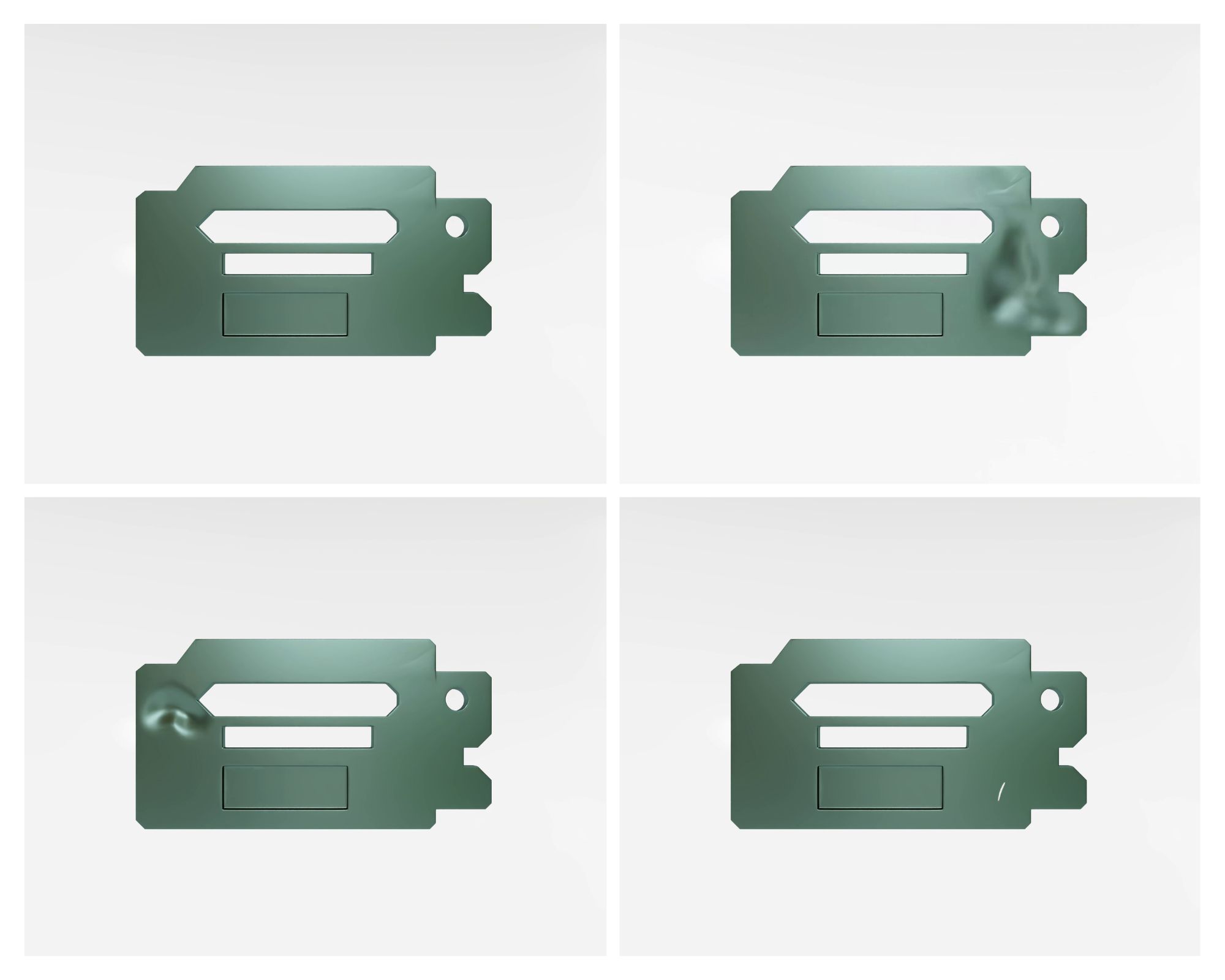
For each defect type, thousands of controlled variations are programmatically generated. Lighting, camera placement, and material conditions are randomized to capture real‑world variability, with multiple viewpoints included for every sample.
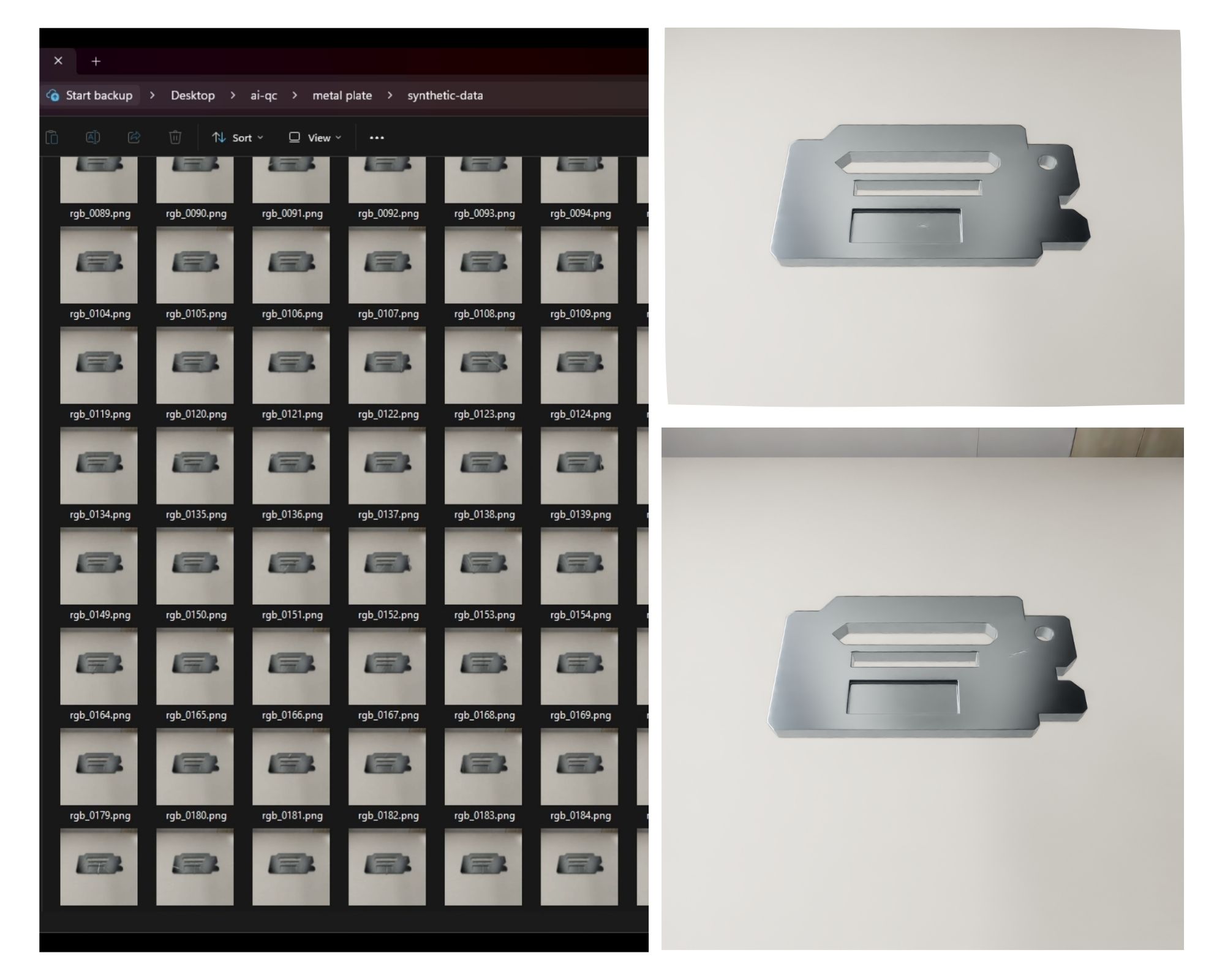
This automated synthetic‑data pipeline reduces training‑dataset preparation from several weeks to just a few days—dramatically accelerating model development while expanding defect scenario coverage.
Testing inside Digital Twin before production
Before deploying the inspection system to the factory floor, it was first validated within a high‑fidelity digital twin of the production environment. This virtual setup replicated real‑world operating conditions, including:
-
Camera placement
-
Lighting configuration
-
Component movement
-
Operational conditions
Within the digital twin, multiple controlled stress scenarios were executed to ensure robustness:
-
Lighting intensity variation
-
Camera angle adjustments
-
Edge-case visibility testing
-
Confidence threshold calibration
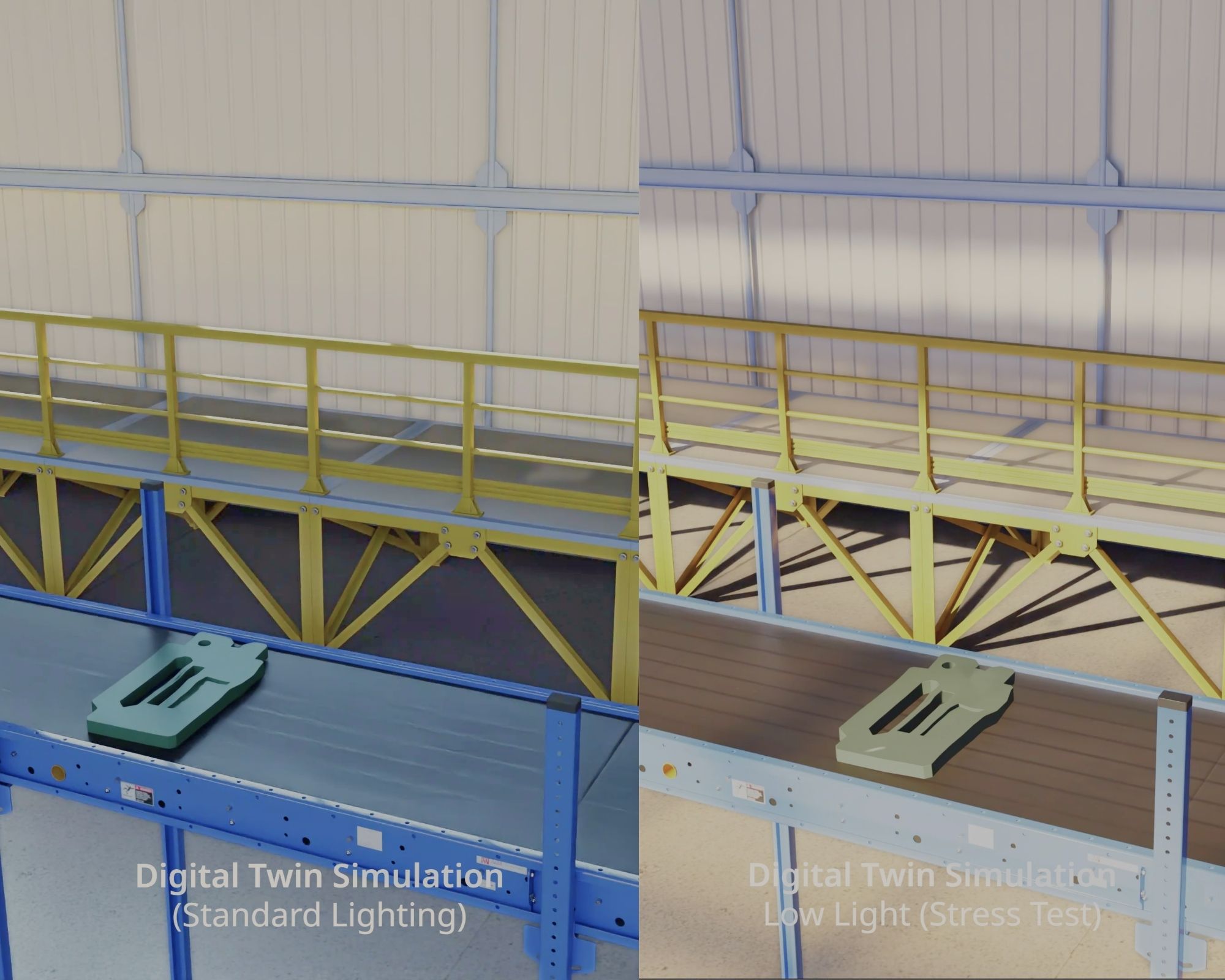
Validating the system in simulation allowed the team to refine detection performance without interrupting live production. As a result, deployment risk was significantly reduced, and on‑line commissioning time was shortened.
Real-time, confidence-based inspection
After digital‑twin validation, the AI system was deployed directly onto the production line for real‑time inspection. Each component is automatically captured and evaluated against trained defect models. The system assigns a confidence score to each prediction and logs results with complete traceability for downstream review.
This enables an exception‑based workflow: instead of inspecting every component manually, operators now focus only on items flagged by the system. This shift reduces inspection effort, increases consistency, and accelerates decision‑making during production.
Measurable impact
75% Reduction in training data preparation time
Real‑world defect capture previously required 4–8 weeks of production sampling. With physics‑based synthetic generation, equivalent datasets were produced in 5–7 days, reducing preparation time by 75% or more.
3× Increase in defect scenario coverage
Historical datasets contained hundreds of defect samples, with rare defects often missing entirely. Synthetic generation expanded this to thousands of controlled variations per defect type, tripling scenario coverage and improving detection of low‑frequency failures.
50% Reduction in manual inspection workload
Operators originally performed 100% manual visual inspection for each component. With AI‑based detection and confidence scoring, inspectors reviewed only flagged exceptions, reducing manual workload by 50% while maintaining traceability.
30% Faster go-live timeline
On‑site tuning and iterative camera‑line calibration typically added 6–8 weeks to deployment cycles. Digital‑twin validation reduced this to 2–3 weeks, accelerating go‑live by 30%.
Reduced scrap and rework
Before deployment, inconsistent detection allowed defects to progress downstream, resulting in periodic rework and scrap events. Earlier detection through synthetic‑trained AI reduced downstream escapes, improving yield and lowering rework cost—especially for welding and casting operations where corrections are expensive.
From reactive detection to proactive readiness
Most inspection systems learn only from past defects, limiting their ability to anticipate rare or emerging issues.
By combining synthetic data generation, physics‑based simulation, and digital‑twin validation, manufacturers can prepare for defect scenarios before they occur in production.
This integrated approach delivers a more resilient and future‑ready inspection workflow.
With:
-
Physics‑based simulation to model defect behavior with engineering precision
-
Large‑scale synthetic dataset creation to expand coverage beyond historical limitations
-
Digital twin validation to tune and optimize inspection performance without disrupting production
-
Real‑time AI inspection to operationalize detection with confidence and traceability
Organizations can shift from reactive quality control to proactive, engineering‑driven defect prevention—reducing risk, improving throughput, and strengthening product reliability.
Explore how synthetic defect data and digital twins accelerate AI model development and validation
Transform Your Inspection Process
Explore a pilot program to evaluate synthetic‑data‑driven inspection for your production line.